
How a swap route works
A swap interface typically helps a user construct a transaction, but the execution depends on smart contracts, liquidity, network conditions, token permissions and transaction settings. Before signing a swap, compare the current quote with the pool route, price impact, slippage setting, token permissions and network fee. After confirmation, check the transaction hash on the correct chain.
Check tokens and permissions
Points programmes may have rules that change, may exclude users or may never convert to a token or benefit. Readers should rely only on dated official terms, understand eligibility and avoid treating speculative community discussion as a contractual promise.
Read points programme rules
A performance claim is useful only with its named network, measurement window, calculation method and source; a points balance alone does not show eligible volume or redeemable value.
Confirm the order details before approval
- Confirm the network and full contract addresses for the assets involved.
- Read the quote's route, expected output, minimum received and expiry or update time.
- Include network fees, approvals and any programme conditions in the decision.
- Compare the wallet prompt with the intended action before signing.
Anatomy of a swap quote
| Field | Displayed before approval | Check against the transaction | After execution |
|---|---|---|---|
| Input and output | Assets and estimated amounts | Network, contract addresses and trade size | Compare the submitted amounts with the receipt. |
| Minimum received | Lowest permitted output | Slippage setting and price impact | Check whether the execution met the minimum. |
| Route | Pools or venues forming the quote | Contracts and any bridge involved | Follow the transactions on the relevant networks. |
| Total cost | Network and service charges | Every fee shown in the wallet | Use the confirmed transaction, not the earlier estimate. |
A quote is a moment in a changing route
A swap quote depends on the selected assets, network, pool depth, route, transaction size and network conditions at the time it is produced. If an aggregator combines pools, the route may include more than one contract. Recording the quote time and the minimum received makes a later comparison more meaningful than saving only the headline exchange rate.
Keep execution costs and campaign rewards apart
A swap's economic result depends on more than the displayed trading fee. Network gas, pool fees, price impact, route length and failed transactions can affect the amount received. Compare the estimate with the minimum received and remember that a reverted transaction may still consume network resources.
Points or cashback, if offered by a programme, are governed by separate conditions and may not offset those costs. Check how rewards are calculated, whether they expire and whether any redemption is guaranteed. A marketing label such as points should not be treated as a cash-equivalent discount without explicit terms.
Crypto swap points programs: rules to check
A crypto swap points program may award points for eligible activity, but its value depends on published rules. Readers should look for the qualifying actions, calculation period, exclusions, account requirements, expiration and whether points can be redeemed at all. A points balance or campaign phrase is not the same as a guaranteed token distribution.
A trading route is a sequence of market decisions
A multi-market trading interface may search across networks or venues and present a suggested route. The user should be able to identify the asset, chain, input amount, expected output, fees, route and any bridge or contract involved before signing. A route preview is an estimate based on available data, not a guarantee that execution will match it.
Market depth and liquidity affect execution. A token can have a displayed price while offering little capacity near that price. Compare the expected trade with pool reserves or order-book depth, and consider how a large transaction may move the price. A convenient interface does not eliminate slippage, network congestion or smart-contract risk.
HyperCore and HyperEVM are distinct execution environments
Funnel's public description refers to assets and services across HyperCore and HyperEVM. Readers should confirm which environment a particular asset or transaction uses, how assets move between environments, and which contracts or bridges are involved. Similar names in an interface do not mean that balances or permissions are interchangeable.
When an operator claims that a route is fee-free, has no slippage or reaches a particular market, check the dated terms and the actual transaction path. Fees can arise from networks, venues, bridges or token mechanics even when an interface does not charge a separate service fee. The exact user cost depends on the transaction and its current state.
Identify the asset before comparing a route
A BTC balance on Bitcoin is not automatically an asset available to a decentralised exchange on another network. A route may require a bridge or a tokenised representation. Confirm the destination network, token contract, bridge or custodian, and redemption terms; the ticker alone does not identify the settlement path.
Once the intended asset is present on the target network, compare its contract address with the quote and wallet prompt. The route determines which contracts a transaction touches: a direct swap, an aggregator path and a bridge route have different dependencies. Check the input, expected output, minimum received, price impact and approvals before signing.
Read a swap quote as a time-bound estimate
A quote is tied to a particular token pair, route, amount and moment. Before comparing two quotes, align the network and trade size, then check the expected output, minimum received, price impact, network fee and any aggregator charge. A displayed rate can change before execution as liquidity and competing transactions move.
The route also determines which contracts a transaction touches. A direct swap, an aggregator path and a route that crosses a bridge can have different dependencies and failure modes. Review the wallet prompt against the quote, verify the token addresses and reject a transaction if the actual spender or output asset differs from the intended trade.
Treat points under their written rules
A points balance is not automatically a token, a cash value or a right to receive a future distribution. The programme should define eligible actions, exclusions, calculation periods, caps, expiry and any redemption or conversion process. If the terms reserve discretion to change or cancel points, readers should account for that before assigning them a value.
Compare the full route, not only the displayed rate
An aggregator may split an order across venues or route it through several assets. Compare the expected output after fees, the minimum received and the final token addresses rather than focusing on a headline exchange rate. A route with fewer steps is not automatically better, but every extra contract or bridge creates another dependency to understand.
Trade size changes the result because available liquidity is finite. A quote for a small amount may not predict the price impact of a larger order. Refresh the quote close to execution, confirm the selected network and read the wallet prompt carefully. If the expected output or spender changes, stop and review the new route before signing.
Treat points as a programme record
Points can be used to record eligible activity, but their meaning depends on written programme terms. Check who can participate, which actions count, how exclusions are applied, when balances update and whether points expire. If a future conversion or distribution is mentioned, look for a defined mechanism and distinguish it from a general possibility or community expectation.
Keep campaign records dated. A screenshot may show an interface state but does not establish that a benefit is redeemable or that the programme will continue. The current terms, account history and any formal announcement are separate evidence. Avoid assigning a cash value unless the programme specifies a binding conversion and the relevant conditions are met.
Verify the quote against the wallet request
Before swapping, verify the network, input and output contract addresses, amount, quote expiry, minimum received, price impact, network fee and spender. Check whether a bridge or third-party contract appears in the route and whether the wallet prompt matches the intended action. A familiar token symbol is not a substitute for confirming the contract address.
A swap is a transaction path, not just a displayed price
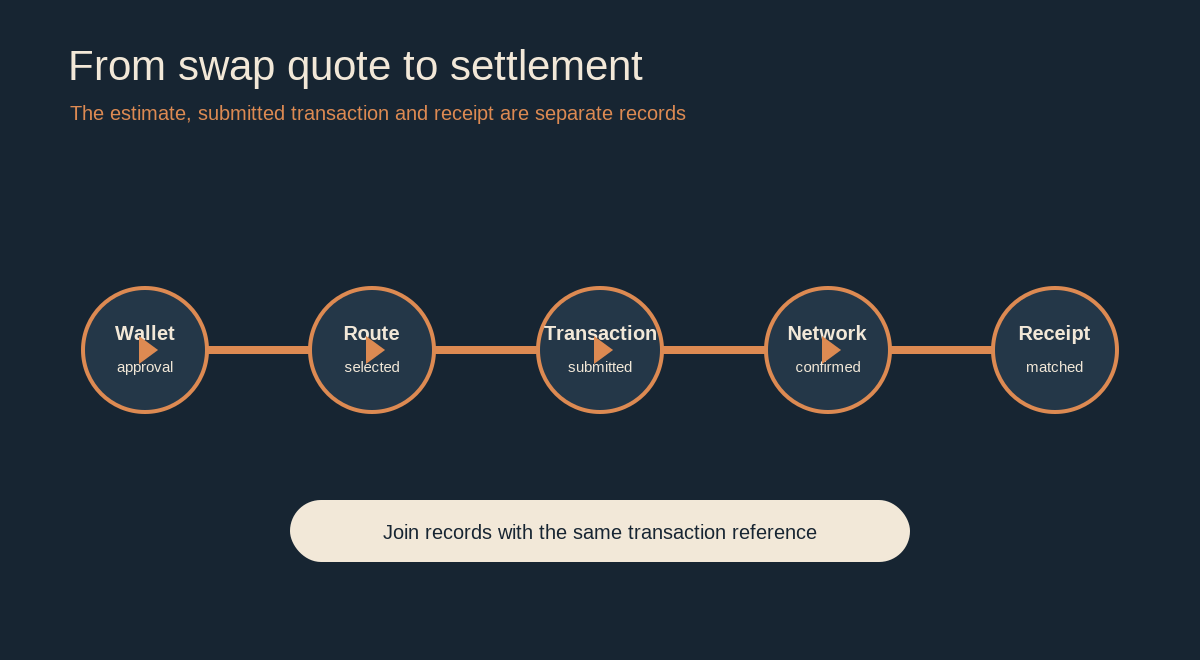
A crypto swap begins with token addresses and a network, then passes through a route, liquidity source and transaction submitted by a wallet. The quoted output is an estimate; the executed result can change with price movement, slippage settings, fees and available liquidity. Users should inspect the minimum received and approval scope before signing.
Points and mining rewards have different rules from a swap. Points may be discretionary or subject to later eligibility criteria; pool rewards are calculated from contributed work under a published method. Keep these balances distinct in any product explanation, and do not imply that points can be redeemed or that a swap creates mining income without current terms proving it.

Questions about swaps, points and settlement
- What should a crypto-points programme disclose?
- Terms should define eligible actions, measurement dates, exclusions, expiry, transferability and any redemption process.
- Do points establish a future token allocation?
- Only dated programme terms can define eligibility or allocation; activity or a displayed balance alone does not create a token entitlement.